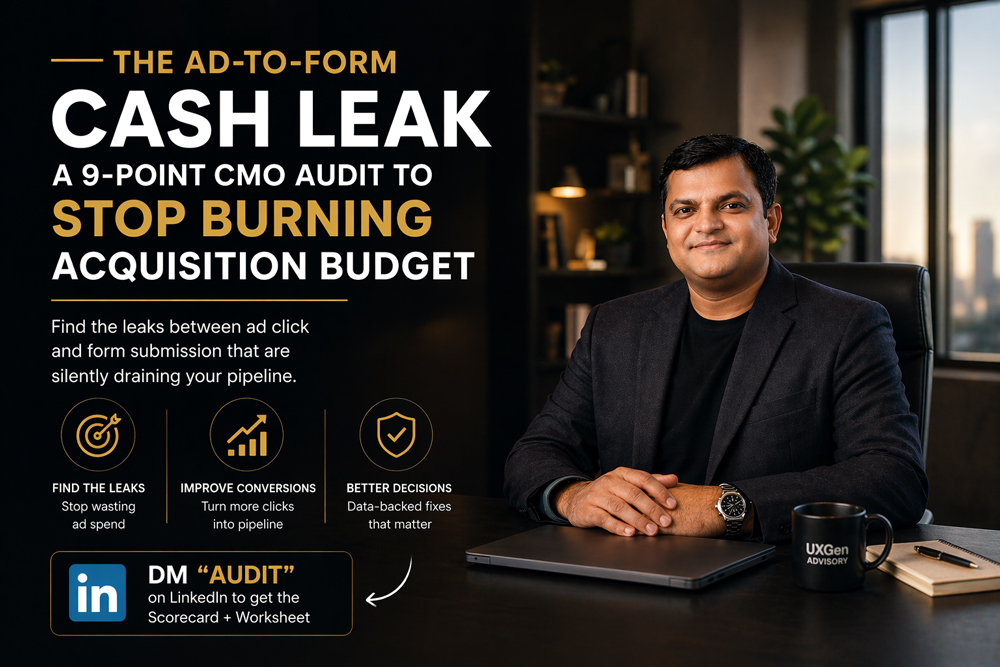
Your paid media team says the campaigns are healthy. The CTR looks fine. Traffic is flowing. Cost per click is sitting right at the benchmark.
Then your sales team says the pipeline is weak.
That gap—between a successful ad click and a booked demo—is where your acquisition budget is quietly bleeding out. A proper landing page conversion audit starts exactly there. Not in Figma. Not in a subjective debate about brand colors. It starts with a ruthless question: Where does paid intent collapse before it becomes qualified pipeline?
- The Core Issue: B2B conversion drop-offs are rarely traffic problems; they are cognitive friction problems.
- The Cost: Contentsquare’s recent benchmark report shows cost per visit rising 9.4%, meaning every leaked click hurts your CAC more than ever.
- The Fix: Align ad intent with page reality (message match), strip internal jargon, move social proof above the fold, and ruthlessly cut form friction.
- The 9-Point Audit: A diagnostic framework covering message match, offer clarity, visual hierarchy, trust signals, form friction, error handling, page speed, CTA specificity, and measurement integrity.
Acquisition isn’t getting cheaper. At the same time, Gartner reports that 67% of B2B buyers now prefer a rep-free experience. Every extra second of confusion on your landing page is competing against higher ad costs and self-directed, impatient buyers.
Here is the exact 9-point, zero-BS audit I use to isolate funnel failure points. Run this before your next board meeting to reclaim your wasted ad spend.
The Illusion of “Good Traffic” in B2B
Average marketing teams often assume low conversion rates are just a byproduct of “complex buyers” or “longer sales cycles.” That becomes a convenient excuse for weak post-click execution.
The reality is much simpler. If your LinkedIn ad promises one thing, and your landing page forces the buyer to do mental gymnastics to understand the offer, you are burning qualified intent. Google explicitly factors landing page experience into your ad Quality Score. They define that experience through usefulness, relevance, ease of navigation, and—most importantly—whether the page meets the expectations created by the ad.
A rough benchmark helps set the stage. Unbounce’s data, drawn from 57 million conversions, puts the median landing page conversion rate across industries at around 6.6%. While not every B2B page will hit that, it’s a stark reminder that saying “we get some leads” is not the same as saying “our funnel is efficient.”
The 9-Point CMO Audit at a Glance
| Audit Point | What to Check | What Fails When Broken |
| 1. Message Match | Headline, subhead, CTA, ad-to-page promise | High bounce rates, immediate loss of trust |
| 2. Offer Clarity | What they get, who it’s for, why it matters now | Clicks without intent progression |
| 3. Above-the-Fold Hierarchy | First screen scannability, direct answers | Shallow engagement, fast exits |
| 4. Proof and Trust | Outcome metrics, logos, risk reducers | High drop-off before form engagement |
| 5. Form Friction | Cognitive load, field count, necessary data | High form abandonment rates |
| 6. Error Recovery | Inline validation, clear labels, helpful states | Rage quitting after starting the form |
| 7. Speed & Device UX | Mobile latency, layout shifts, heavy scripts | Wasted paid clicks (delay kills intent) |
| 8. CTA & Handoff Logic | Button copy, routing, thank-you page momentum | Low-quality leads, broken next steps |
| 9. Measurement Integrity | Event tracking, source capture, field drop-off | Bad diagnosis, treating symptoms not disease |
Phase 1: Fix First-Screen Friction
If you lose them in the first three seconds, the rest of the page doesn’t matter.
1) Message Match is the First Leak
If your ad says “Book a Revenue Leakage Audit” and the landing page opens with “We Build Better Experiences,” you have already lost the thread. The user feels tricked.
Google’s definition of landing page experience hinges on expectation. When that expectation breaks, the click becomes expensive curiosity instead of qualified intent.
- The Audit: Is the exact promise in the ad repeated in the H1? Is the CTA the literal action the ad implied?
2) Offer Clarity Must Beat Internal Jargon
Most B2B landing pages use framework words and category jargon that make sense in internal Slack channels, but mean nothing to the buyer. NN/g’s usability guidance is blunt: interfaces must use concepts familiar to users, not internal vocabulary.
- Bad Example: “Accelerate digital transformation through omnichannel UX intelligence.”
- Elite Example: “Find the exact landing page leaks reducing pipeline from your paid traffic.”
3) The First Screen Does the Heavy Lifting
Above the fold still matters. NN/g found users spend 57% of their page-viewing time above the fold, and 74% within the first two screenfuls. You cannot waste this real estate on brand theater or giant stock photos of people pointing at laptops.
- The Audit: Does the first screen answer three things instantly: What is this? Is it for me? Why should I trust you?
Phase 2: Reduce Friction Before and Inside the Form
B2B buyers are not scared of forms. They are scared of wasting their time and risking their reputation.
4) Proof Has to Earn the Next Click
Do not bury your case studies and ROI metrics at the bottom of the page. Proof must support the decision before the form becomes a commitment. As buyers increasingly demand rep-free, self-serve experiences (McKinsey’s 2024 B2B Pulse notes decision-makers use an average of ten channels), your page must do the persuasion work on its own.
- The Audit: Are there contextual logos, outcome metrics, and real executive quotes placed right next to the primary CTA?
5) Form Friction is a Cognitive Load Problem
Yes, a 10-field form hurts. But the deeper issue is mental effort. NN/g frames good forms around structure, transparency, and clarity. Stop asking for data you can buy.
- The Audit: Are you asking for company size, revenue, and job title? Cut them. Use data enrichment tools (like Clearbit or ZoomInfo) on the backend. Ask for a business email and let them in.
6) Bad Error Handling Quietly Kills Completions
Baymard’s research found that 31% of sites still lack inline validation. If a VP types a personal email by mistake, and the page wipes all their data with a tiny red “Error” at the top of the screen, they will leave.
- The Audit: Do errors appear beside the field? Are they constructive? Does the form preserve entered data when an error occurs?
Phase 3: Protect Speed, Handoff, and Measurement
The transaction isn’t over until the CRM logs a qualified opportunity.
7) Speed is Not a Technical Footnote
Latency destroys paid efficiency. Google’s “Milliseconds Make Millions” report highlighted how even 0.1-second improvements drive conversion gains. Delay reduces momentum. If your page takes 4 seconds to load on mobile because of tracking scripts, you are funding ad networks for zero return.
8) CTA Copy and Post-Submit Logic
“Submit” is a UI term. It has no business value. Your CTA must describe the next step in the buyer’s language: “Get My Audit,” “See Enterprise Pricing,” or “Start the Assessment.” Furthermore, the thank-you page shouldn’t be a dead end. Use it to route them to a calendar link or high-value asset.
9) Weak Measurement Creates Fake Diagnoses
This is the least glamorous but most critical part of the audit. If you cannot see field-level drop-offs, you will redesign the whole page when the real problem was just a broken phone number validation script.
- The Audit: Do you have clean UTM capture, form-start vs. form-submit tracking, and a CRM status feedback loop?
The Boardroom Scorecard (Lead Magnet)
To stop the bleeding, you need to score your funnels objectively. Score each of the 9 audit points above from 0 to 2:
- 0 = Broken or unclear
- 1 = Acceptable but weak
- 2 = Strong and aligned
Interpretation:
- 0-8: Serious post-click leakage. Turn off ads until fixed.
- 9-13: Mixed performance. You are likely wasting 30%+ of your budget.
- 14-18: Strong foundation. Move to A/B testing and experimentation.
Stop guessing. Start diagnosing.
Want the exact boardroom-ready worksheet I use to evaluate enterprise funnels?
DM me the word AUDIT on LinkedIn, and I’ll send you the scorecard and diagnostic worksheet directly.
Why UXGen Advisory Is the Executive Partner for Funnel Turnarounds
Most design agencies treat low conversion as a screen-design problem. We do not.
At UXGen Advisory, we approach this strictly as a conversion intelligence problem. We are specialists in UX Audits and Conversion Optimization for mid-market and enterprise B2B companies. We look at the entire post-click chain: the ad promise, landing page clarity, proof sequencing, form friction, sales handoff, and measurement integrity.
We use rigorous heuristic evaluation, behavior analysis, and business-priority scoring to isolate the exact points where your buyers are abandoning you. We don’t sell pretty screens. We isolate commercial friction and translate it back into pipeline revenue.
Case Study: Stopping a B2B Cash Bleed for an Industrial SaaS
- Client Context: A mid-market industrial SaaS company was driving healthy paid search and LinkedIn traffic to their demo pages. However, form completions were stagnant, CAC was rising, and sales complained about weak lead quality.
- What We Found: We ran our proprietary Heuristic UX Conversion Audit. The ads promised a “Cost-Reduction Assessment,” but the landing page opened with generic brand messaging. Trust proof was buried at the bottom. Worse, the form asked for eight fields upfront (including implementation timelines), creating massive cognitive overload.
- What We Changed: We rebuilt the conversion logic. We rewrote the H1 to perfectly match the ad intent. We moved industry-specific proof above the fold. We slashed the form down to four fields, relying on progressive profiling later in the cycle, and implemented robust field-level drop-off tracking.
- Measurable Outcome: Within the first testing cycle, form completions increased by 31%. Cost per qualified opportunity dropped by 18%, and the sales-accepted lead rate rose by 22%.
- The Insight: “We didn’t need more traffic. UXGen Advisory showed us we just needed a cleaner handoff between paid intent and the form. They fixed our pipeline without us having to spend another dollar on ads.” – CMO, Industrial SaaS.
Frequently Asked Questions (FAQ)
- What is a landing page conversion audit?
A landing page conversion audit is a structured, data-backed review of a page’s ability to turn paid traffic into qualified action. Unlike aesthetic reviews, it focuses on relevance, usability, trust, cognitive friction, speed, and tracking quality. It identifies exactly where users drop off and why. - How does landing page experience affect paid media performance?
The ad click is only the start. Platforms like Google factor landing page experience into Quality Score, looking at relevance and usability. If a page breaks the ad’s promise or is hard to navigate, your Quality Score drops, your cost per click rises, and you pay a premium for traffic that bounces. - What is a good conversion rate for a B2B landing page?
While Unbounce notes a 6.6% median across all industries, B2B varies heavily based on traffic intent, offer type, and deal size. Instead of chasing a generic vanity metric, focus on baseline improvement. A successful audit should demonstrably lower your cost per qualified opportunity. - How many form fields should a B2B lead-gen page have?
Data shows 3 to 5 fields is optimal. However, the real rule is minimizing cognitive load. Ask only for the data strictly necessary for the next step (usually a business email). Use backend data enrichment tools to append company size, title, and industry without taxing the user. - Does above-the-fold content still matter?
Absolutely. Research from NN/g shows users spend 57% of their viewing time above the fold. Your core value proposition, relevance to the user, and primary trust signals must be immediately visible without scrolling, or you risk an instant bounce. - Why do B2B buyers abandon forms even when the offer is good?
They abandon forms when the cognitive cost outweighs the perceived value. Common culprits include premature qualification questions (asking for budget too early), aggressive error handling that deletes their inputs, and lack of clarity on what happens immediately after they click submit. - How is a CRO audit different from a general UX audit?
A general UX audit evaluates broad usability and overall platform experience. A CRO (Conversion Rate Optimization) audit is laser-focused on commercial outcomes. It specifically targets the friction points preventing a high-value action, directly tying design and layout changes to pipeline revenue. - How should a landing page be optimized for AI search?
Google states that standard SEO fundamentals still apply for AI Overviews. Focus on creating highly structured, extractable content (like bullet points and tables), answering questions directly, and providing original data or expert insights. Do not create separate “AI content”; create highly readable, expert-driven human content.